
Why TikTok Stamps Every Saved Video With Its Logo
The stamp is added on export — the clean file was there first.
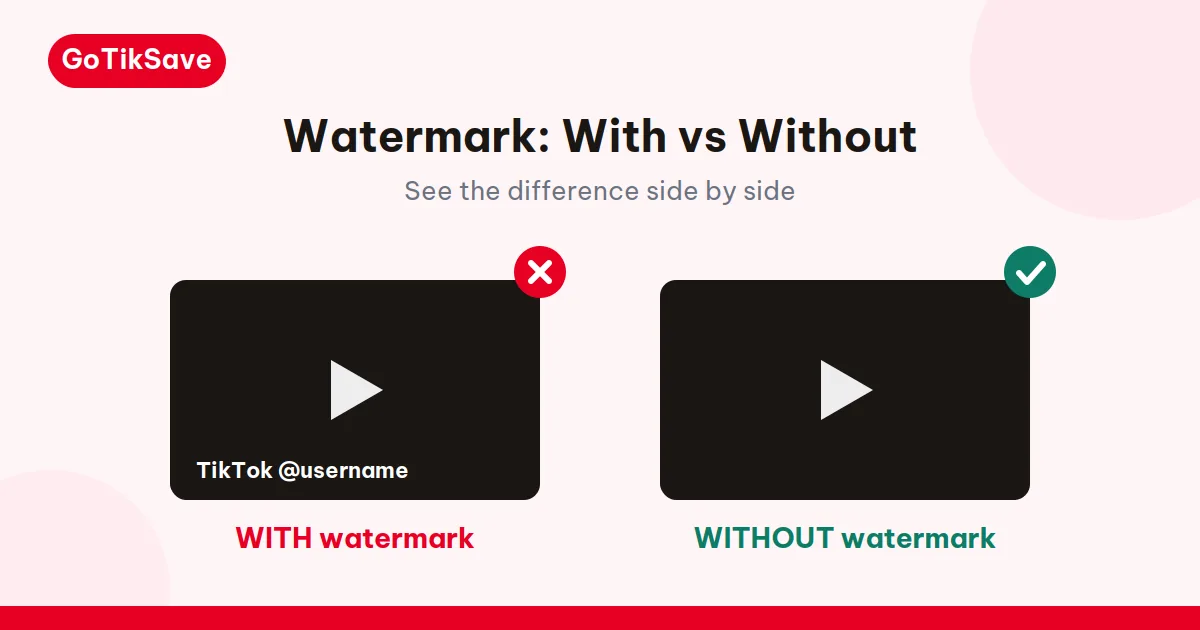
Save any video through TikTok's own app and you get a souvenir stamped across it: the TikTok logo drifting between corners, the creator's username trailing behind it. It's deliberate, it's on every video, and it prompts an obvious question: why does TikTok insist on branding a video that's leaving its platform — and is the clean version real?
Short answers: the watermark is TikTok's attribution and branding system, and yes, the unstamped file genuinely exists, because TikTok itself stores one. This article explains what the watermark is, the technical reason a clean copy is fetchable, and what that means for you. If you just want the file, our GoTikSave TikTok video downloader fetches it — paste a link, save the MP4 without the stamp.
What the watermark actually is
TikTok's watermark has two parts: the musical-note logo, which drifts between the corners of the frame so it can't be removed with a single crop, and the creator's @username, rendered in a semi-transparent bar. On longer videos it pulses in and out rather than sitting static. It's not subtle, and that's the point.
Douyin, TikTok's Chinese sibling, watermarks its downloads identically with Douyin's own branding. The same logic throughout this article applies to both.
Added at download time, not at upload
This is the key technical detail most people miss, and it's what makes "no watermark" downloaders possible at all.
The video file TikTok stores on its servers — the one that plays in your feed — does not have the watermark baked in. The stamp is composited when you use TikTok's Save Video button: the app (or server) takes the clean source file, overlays the logo and username, and hands you the stamped export. Two different files, same video.
That's why fetching a clean copy isn't "hacking" anything. A downloader simply requests the source file — the one TikTok already stores and streams to every viewer — instead of the stamped export. No pixels are removed, no AI inpainting, no trickery. The clean file was there all along; TikTok's own button just doesn't offer it.
Why TikTok insists on the watermark
Attribution. The username in the watermark means a video shared anywhere still points back to its creator. Every repost becomes free advertising for the platform and credit for the creator, even when the video travels to Instagram, WhatsApp, or YouTube Shorts.
Platform branding. Every watermarked video circulating off-platform is a TikTok billboard. The drifting logo is engineered to survive cropping, which is exactly why casual screen recording doesn't cleanly remove it.
Friction against re-uploading. The watermark makes it slightly annoying to pass someone else's video off as your own — the original @username is right there in the frame. It doesn't stop determined reposters, but it raises the effort floor, which is all TikTok needs.
None of this requires the stamp on the source file. TikTok keeps an unbranded copy of each public video for playback in its own app and website. The watermark exists on the export path only.
Why other platforms punish watermarked re-uploads
The watermark doesn't just annoy viewers — it actively hurts the video on other platforms. Instagram has stated publicly that its ranking system downranks Reels showing third-party watermarks; a TikTok logo in the corner is a direct signal that the content is recycled, and the algorithm treats it accordingly. YouTube Shorts applies similar logic: reused content with visible watermarks gets less distribution than original uploads.
This is the practical reason creators care about the clean file beyond aesthetics. A watermarked re-upload starts with an algorithmic handicap on every platform it touches. The clean source file — identical content, no stamp — is treated as a fresh upload. Same video, different reach.
It also explains why "just crop the watermark out" is bad advice for creators: cropping changes the aspect ratio and framing, which reads as low-effort to both viewers and ranking systems. Fetching the unstamped source preserves the original composition exactly as the creator framed it.
What this means for you, practically
Downloading the clean file doesn't harm the video. Since the source file is what TikTok streams to viewers anyway, the "no watermark" version is identical in quality to what you watched — full source quality, no re-encode, no quality penalty for skipping the stamp. If a "no watermark" download ever looks blurry, the tool fetched a low-resolution copy; the method itself costs nothing in quality.
Removing the watermark doesn't change who owns the video. The creator still owns the content, stamp or no stamp. The watermark is TikTok's attribution mechanism, not a legal force field. If you share or reuse someone's video, credit the human who made it — that's real attribution, and it matters more than a bouncing logo.
For personal, offline viewing, downloading is generally accepted. Re-uploading someone else's video as your own, with or without the watermark, can violate copyright. Our Disclaimer has the full picture; nothing here is legal advice.
The desktop "Save" button stamps too. A persistent myth says downloading from TikTok's website gives you a clean file while only the app watermarks. It doesn't — the web share dialog runs the same export path and produces the same stamped file. There is no official clean-download button on any TikTok client; the unstamped file only ever travels through playback, which is exactly what downloaders request.
Related tools
This explainer is the hub for our format-specific downloaders:
- GoTikSave TikTok video downloader: the main tool — TikTok and Douyin videos, no watermark, full source quality.
- Douyin video downloader: Douyin-first, built for links that won't open outside China.
- TikTok MP3 downloader: just the audio stream, for sounds worth keeping on their own.
- TikTok slideshow downloader: photo-carousel posts — the images plus the soundtrack.
- TikTok story downloader: stories, saved before the 24-hour expiry.
- Download TikTok videos on iPhone: the iOS walkthrough — Safari, Files, Photos, no app needed.
Frequently asked questions
Why does the watermark move around instead of staying in one corner?
To survive cropping. A static corner logo can be removed by trimming the frame; a logo that drifts between corners and pulses in and out can't be cropped away without destroying the video. It's a deliberate anti-removal design — and it's also why the "just crop it out" advice you see online produces mangled videos.
If the watermark is added at download time, why doesn't TikTok offer a clean download option?
Because the watermark is the point. TikTok wants its logo traveling with every video that leaves the platform — it's free advertising and automatic creator credit. Offering a clean export would defeat the branding purpose. The clean source file exists for playback, not for export, and TikTok has no business reason to hand it out through its own button.
Do creators get to choose whether their videos are watermarked?
No. Individual creators can't disable the watermark on TikTok's Save Video button — it's platform-wide and non-negotiable. A creator who wants to share a clean copy of their own video has to fetch the source file the same way a downloader does, or export from their original project before uploading.
Why is the watermark sometimes bigger or in a different position?
It varies by app version, video aspect ratio, and download method. TikTok tweaks the watermark's size and behavior across updates, and videos with unusual aspect ratios get the stamp placed wherever it fits. The underlying mechanism — composited at export time — stays the same regardless of how it looks.
Does the watermark affect video quality or file size?
Marginally. The stamped export is a re-encode of the source file, so in strict technical terms it's one generation removed — but the difference is imperceptible. The visible cost isn't quality, it's the logo itself sitting on top of the content. File size barely changes; a logo overlay compresses to almost nothing.
Why do re-uploaded TikToks on YouTube Shorts still show the TikTok logo?
Because the re-uploader saved the video through TikTok's own button (or a tool that fetched the stamped export) and reposted it as-is. The watermark survives the trip because it's baked into the exported file's pixels. YouTube's system doesn't remove it — and increasingly, platforms downrank content with visible third-party watermarks, which is one practical reason creators want the clean file.